Real Estate Information Archive

Blog

Displaying blog entries 1-10 of 86

Home Prices Are Becoming More Negotiable

You find a home you love, check the price, calculate the monthly payment—and close the app.

If that sounds familiar, there’s good news: buyers may have more negotiating power in today’s housing market.

More homes are sitting on the market, while fewer buyers are competing for them. That’s pushing sellers to lower prices and make their homes more affordable.

4 Out of 10 Sellers Are Cutting Prices

According to Housing Wire Data, more than 40% of sellers are reducing their asking price.

That means more than 4 out of every 10 homes are seeing price cuts.

Why? Sellers know buyers have more choices. If a home isn’t attracting offers, lowering the price can be the best way to get buyers’ attention.

As Danielle Hale, Chief Economist at Realtor.com, puts it:

“Sellers are meeting the market with more realistic asking prices.”

Home Prices Are Becoming More Realistic

Price cuts aren’t the only change.

According to Realtor.com, July 2026 had the lowest median list price for any July in five years.

That doesn’t mean homes are suddenly cheap. Home prices are still higher than before the pandemic, and affordability remains a challenge.

But sellers are becoming more realistic about what buyers can afford.

That could mean more opportunities to negotiate—not just on the price, but potentially on repairs, closing costs, and other terms.

What This Means for Buyers

You may not be able to afford every home you see, but don’t assume everything is out of reach.

Today’s market may give you more room to negotiate than you think.

Before ruling out a home based on the asking price, talk with a local real estate agent. They can help you identify price reductions, compare similar homes, and find opportunities where sellers may be willing to work with you.

Sellers are becoming more flexible, and that could create new opportunities for buyers.

If you’re thinking about buying a home, now may be a good time to see what’s actually negotiable in your local market.

Should You Wait for Mortgage Rates to Drop?

If you’re waiting for mortgage rates to fall before buying a home, you may be waiting longer than you think.

For many buyers, mortgage rates have become the biggest reason to stay on the sidelines. The hope is that waiting a few more months will bring significantly lower rates and make homeownership more affordable.

But what if that big drop doesn’t happen?

Current forecasts suggest mortgage rates could remain in the low-to-mid 6% range through at least mid-2027, rather than falling dramatically in the near future.

A recent survey found that 42% of people expect mortgage rates to fall below 5% this year. However, forecasts from Fannie Mae, the Mortgage Bankers Association, and Wells Fargo point toward rates remaining relatively steady.


Inflation is one reason. Mortgage rates are influenced by inflation, economic conditions, Treasury yields, Federal Reserve policy, and other factors. With inflation still putting pressure on the economy, a significant decline in mortgage rates may not happen as quickly as many buyers hope.

There’s also an important matter of perspective. Mortgage rates in the 6% range may feel high compared with the historically low rates available during the pandemic, but they are not unusual from a historical standpoint. Mortgage rates have spent much of their time between 5% and 10%.

That means waiting for another return to 3% or 4% rates may not be the most realistic strategy. Instead, buyers may want to focus on finding ways to make the current market work for them.

For example, new construction homes may come with incentives such as rate buydowns, closing-cost assistance, price reductions, or upgrades. Buyers can also ask lenders about adjustable-rate mortgages (ARMs), which may offer a lower initial rate for those who don't plan to stay in the home long-term.

Another option is a mortgage rate buydown, which can potentially lower the interest rate and monthly payment. In some cases, buyers may also find opportunities with assumable mortgages, allowing a qualified buyer to take over a seller’s existing loan and its potentially lower interest rate.

None of this means you need to rush into buying a home. Your financial situation, goals, and timeline should always come first. But if you’re ready to move, waiting indefinitely for lower rates may not necessarily put you in a better position.

Mortgage rates are only one part of the equation. Home prices, inventory, seller incentives, loan programs, and your personal finances all play a role in determining affordability.

Before putting your home search on hold, talk with a trusted real estate professional and lender. They can help you compare different scenarios and determine whether waiting—or making a move in today’s market—makes the most sense for you.

The perfect mortgage rate may be impossible to predict, but the right strategy can make today’s market much easier to navigate.

Why Real Estate Continues to Be America's Most Trusted Long-Term Investment

For more than a decade, Americans have consistently ranked real estate as their preferred long-term investment—and the latest data shows that confidence is stronger than ever. Despite changing market conditions, fluctuating interest rates, and economic uncertainty, homeownership continues to stand out as one of the most trusted ways to build long-term wealth and financial security.

According to Gallup's annual survey, real estate has been named the best long-term investment for the 14th consecutive year, outperforming stocks, gold, savings accounts, bonds, and even cryptocurrency. That level of consistency speaks volumes. While markets naturally experience cycles, the long-term value of owning real estate has remained remarkably resilient.

Homeownership offers benefits that extend well beyond the value of the property itself. As homeowners make monthly mortgage payments, they build equity—creating wealth over time while investing in a place they can truly call their own. Historically, home values have appreciated over the long term, making real estate one of the most dependable assets for individuals and families looking to strengthen their financial future.

Although today's housing market presents challenges, including higher mortgage rates and affordability concerns, national home prices continue to show long-term growth. While some local markets may experience temporary price adjustments, these shifts are generally modest compared to the substantial appreciation many homeowners have experienced over the past several years. Real estate has always been a long-term investment, and those who plan to stay in their homes for several years are often well-positioned to benefit from continued equity growth.

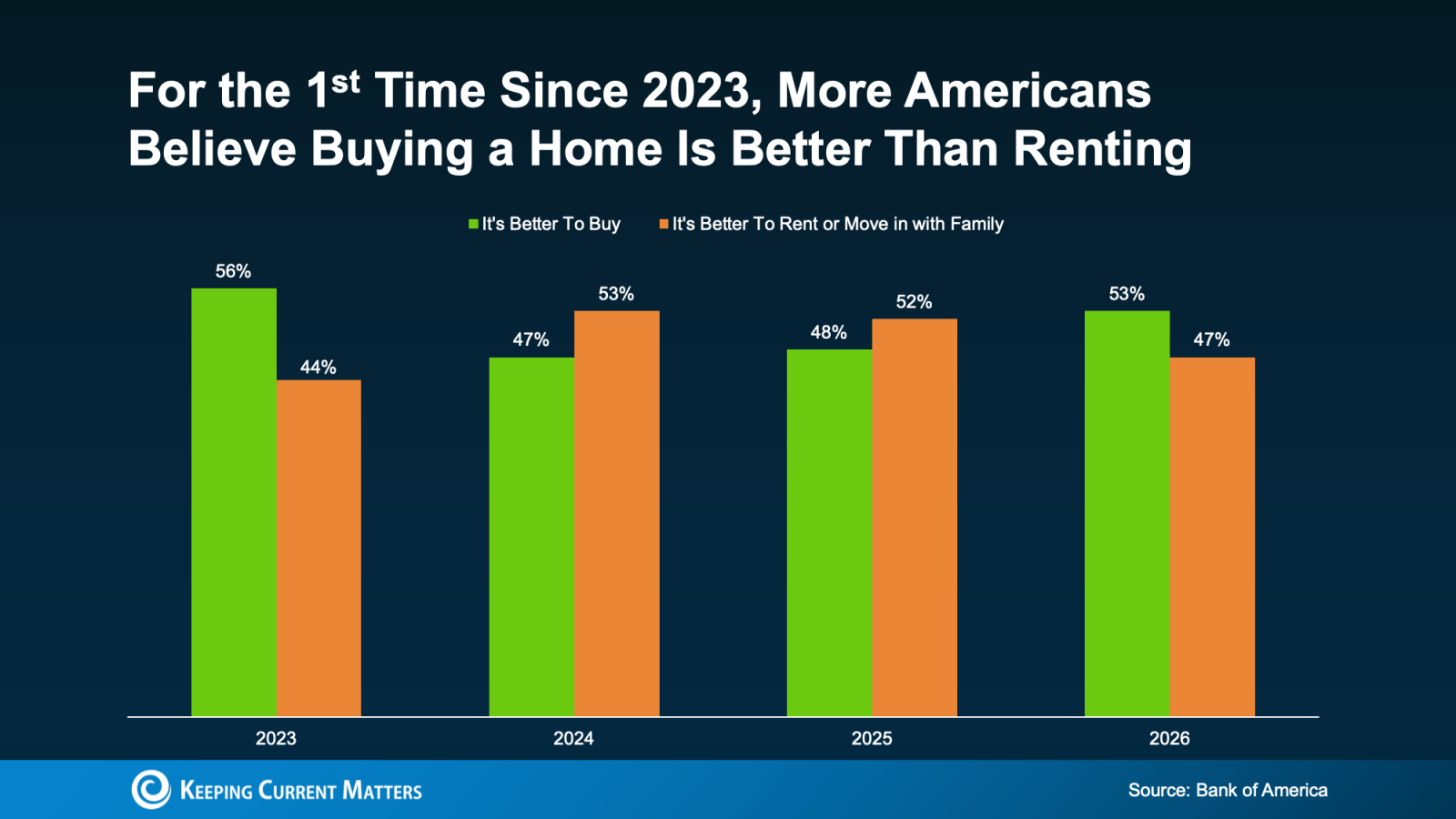
Consumer confidence in homeownership is also increasing. Recent research from Bank of America's Homebuyer Insights Report found that 53% of Americans now believe buying a home is a better option than renting or living with family—the first time buying has taken the lead since 2023. Even more encouraging, 90% of respondents believe a home is a valuable investment, while 94% say homeownership provides stability, reflecting growing optimism about owning a home.

These findings highlight an important reality: purchasing a home is about far more than financial returns. A home provides security, stability, and a sense of belonging. It becomes the place where families grow, milestones are celebrated, and lifelong memories are created. Unlike other investments that exist only on paper, a home offers daily value while simultaneously helping build long-term wealth.

Every buyer's journey is unique, and the right time to purchase depends on individual goals, finances, and lifestyle. That's why working with experienced real estate professionals is so important. Understanding current market conditions, available financing options, and local neighborhood trends can help buyers make informed decisions with confidence.

Whether you're purchasing your first home, upgrading to fit your changing needs, or investing in your future, real estate continues to offer opportunities that extend far beyond today's market headlines. With the right guidance and a long-term perspective, homeownership remains one of the most rewarding investments you can make.

If you're considering buying a home and want to explore your options, our team is here to help. We'll provide expert advice, local market insights, and personalized guidance to help you make informed decisions and confidently take the next step toward your real estate goals.

Tips to Achieve Your Full Potential Equity

by

The real estate market is constantly evolving, presenting homeowners with challenges in determining the accurate value of their properties. In today's era of rapid fluctuations, it is essential to equip yourself with the right knowledge and tools to make informed pricing decisions. There are three crucial factors to consider when assessing your home's worth.

Online estimators offer a convenient starting point for obtaining a rough estimate of your home's value. While they may not provide pinpoint accuracy, these tools, readily available on reputable real estate agents' websites and portals, can provide a general idea of where your property stands in the market.

Traditionally, real estate professionals would consider comparative home sales data from the past six months. However, the current market volatility demands a shift towards using more recent comps. Notably, 2022 and 2023 witnessed a significant doubling of mortgage interest rates within a six-month span, causing home prices to respond accordingly. To ensure accurate pricing, it is crucial to work with a seasoned real estate agent who can identify and leverage the most recent comparable sales.

While research and analysis are valuable, nothing compares to the expertise of a professional real estate team. Their experience and training enable them to price your home accurately from the outset. A skilled agent can identify the key amenities and upgrades that will yield the highest return on investment, as well as develop a tailored marketing plan to outshine competitors.

Evaluating the obvious and the subtle differences between your home and the comparable sales can make the difference in achieving your full potential equity in the least market time with the fewest deterrents or not.

In the ever-changing real estate market, determining your home's value requires a multifaceted approach. By utilizing reliable online tools, considering recent comps, and collaborating with an experienced real estate team, you can confidently navigate the dynamic market and price your home appropriately. If you have any questions or need assistance with real estate matters, please feel free to reach out to me. I am here to serve as your dedicated resource for all your real estate needs.

Owning a home is not only a place to live but also a valuable asset that can contribute to long-term wealth accumulation. Two key factors that play a vital role in increasing a homeowner's wealth are appreciation and amortization. Understanding how these factors work can provide homeowners with insights into building substantial financial equity over time.

Appreciation refers to the increase in the value of a property over time. Real estate markets tend to experience appreciation in the long run, although it can fluctuate in the short term. This appreciation can significantly benefit homeowners' wealth accumulation in several ways.

As a property appreciates, the homeowner's equity, which is the difference between the property value and the mortgage balance, increases. This equity serves as an asset that can be leveraged for future financial endeavors.

Capital Gains: When homeowners decide to sell their property, the appreciation becomes recognizable. The difference between the purchase price and the selling price results in a capital gain, which can be taxed at favorable rates. Homeowners benefit from an exclusion of up to $500,000 of capital gain for married taxpayers filing jointly.  If the gains exceed the exclusion, they are taxed at a lower capital gains rate.

Amortization refers to the gradual repayment of a mortgage loan over time. It is facilitated through monthly mortgage payments, which consist of both principal and interest. With each mortgage payment, a portion goes towards reducing the principal balance of the loan. This reduction in debt increases the homeowner's equity in the property, effectively building wealth over time.

Amortization acts as a form of forced savings. Homeowners are essentially paying themselves by building equity with each payment, rather than paying rent to a landlord. As the mortgage balance decreases, homeowners gain ownership of a more significant portion of the property, leading to increased wealth.

As equity grows, homeowners can access it through home equity loans or lines of credit, allowing them to invest in other ventures or make home improvements that can further enhance the value of their property.

Understanding the dynamics of appreciation and amortization is crucial for homeowners looking to accumulate wealth through their real estate investments whether it be a home or a rental. Appreciation allows for capital gains and the growth of equity, while amortization steadily reduces debt and builds equity over time. By leveraging these two factors effectively, homeowners can secure their financial future and take advantage of the long-term wealth-building potential of homeownership.

Turn Back Time

by

As the expression goes, "if I could turn back time", maybe you'd would do some things differently.  If you're wanting to buy a home, the regret may come from not getting a mortgage when rates were half of what they are today.  There may not be a way to literally "turn back time" but you may still be able to get a mortgage with last years' rates.

Let's say a home was sold in the fall of 2021 for $350,000 with a 3% FHA loan.  Today, winter of 2023, the home is on the market for sale at $400,000.  There are buyers who have $40,000 for a down payment, who like the home, and want to purchase it.

At today's mortgage rate of 6.42%, the $360,000, 30-year mortgage payment would be $2,2565.54 for the principal and interest.  They have been looking for a year and in the past 12 months, the mortgage rates have doubled which will stretch their finances along with all the other inflationary pressures.

Their incredibly savvy agent has learned that the underlying mortgage is an FHA mortgage at 3.00% with a little less than 29 years remaining.  This loan could be assumed by an owner occupant at the current rate which would save the buyer a considerable amount of interest.

The problem is that the buyers do not have enough cash to buy the equity.  The unpaid balance is $328,902 which makes the equity about $71,000 which is more than the $40,000 they have available.

The agent believes that with the buyer using the $40,000, they should be able to get a second mortgage for the difference of $31,000.  While it may not be possible to get a 30-year term on the second, it may be possible to get a 30-year amortization on the payment and have the second loan due in ten years.

Sources for the second loan could be the borrower's local bank, a credit union, a relative or other investor not happy with what they're earning on cash in the current market.

This could save the buyer over $600 a month.  In addition to a lower payment, assumptions on FHA loans have lower closing costs, they're easier to qualify for, and the lower mortgage rates allow them to amortize faster than a higher rate mortgage.


Buyer Scenario #1 ... New Mortgage


Purchase Price

$400,000

10% Down Payment

$40,000

Mortgage at 6.42% for 30 years

$360,000

Principal & Interest Payment

$2,256.54

Future Value at 3% Appreciation in 7 years

$493,342

Future Unpaid Balance

$325,062

Future Equity

$168,280


Buyer Scenario #2 ... Assumption


Purchase Price

$400,000

10% Down Payment

$40,000

Assume Existing Mortgage at 3% for 28.8 Remaining Years

$328,871

Assume Principal & Interest Payment

$1,386.66

New Second Mortgage at 6.5% for 30 years

$31,098

Payment on Second Mortgage

$247.32

Total Monthly Payments

$1,633.94

Monthly Savings

$622.55


Future Value at 3% Appreciation in 7 years

$493,342

Unpaid Balance on 1st Mortgage in 7 years

$266,313

Unpaid Balance on 2nd Mortgage in 7 years

$35,379

Future Equity in 7 years

$191,649

Increased Equity Over New Mortgage

$23,369


In the early 1980s, both Fannie Mae and Freddie Mac added "due on sale" and escalation of interest rate clauses to the standard verbiage on notes and mortgages.  From a practical standpoint, this ended assumptions of most conventional mortgages. 

FHA and VA continued to be assumable by anyone, regardless of credit, until 12/1/86 and 3/1/88 respectively.  At that time, an owner-occupant could assume the existing interest rate but had to qualify to do so.  Mortgage rates went down over the next three decades with only some temporary increases until January 2022 when they began to increase dramatically.

If a buyer had to qualify to assume a mortgage, especially if it was higher than the current rates, there was no compelling reason to put more money down for an existing mortgage.  Now, in 2023, this environment has changed.

Many buyers who purchased using an FHA or VA mortgage in the past two to three years, benefitted from some of the lowest rates in over 50 years.   The equities in these properties are still within reason to either assume cash to equity or consider a second mortgage for part of the equity.

If you'd like to learn more about how to assume FHA, VA, or USDA mortgages at lower rates than currently available on new mortgages, contact your real estate professional.  Unfortunately, some agents are not aware of how assumptions work.  Give us a call and we can walk you through the process and even have a spreadsheet that will analyze the comparison for you.

Seller's

FIVE THINGS BUYERS SHOULDN’T COMPROMISE ON

by

When buying a home, there are things you should never compromise on or you will likely regret it!

  1.  The Floor Plan:  It is difficult and expensive to reconfigure a homes floor plan.  If a home doesn’t have the minimum number of rooms or the flow of the main living areas you want, you should cross it off your list.
  2. The School District: You need to carefully consider your neighborhood’s school district and even get a map of the boundaries to make sure your home is within the correct district.
  3. The Neighbors:  Pay attention to the condition of neighboring homes.  Not only do you have to live with your neighbors on a daily basis, but it can affect your future resale value.  Knock on the doors and meet the neighbors prior to submitting an offer.
  4. The Budget:  Consider all expenses, monthly mortgage payment, homeowner association dues, utility costs and real estate taxes.  Beyond the sales price make sure you will be financially comfortable.
  5. The Commute:  Test-drive the route between your home and office to be certain of the time spent commuting.

Give us a call, we'd love to help you with your real estate needs!

Cindy Wood Realty

801-278-0999​​


Yes, Feds Reduced the Rates!

by

Yes the feds cut interest-rates but how does this affect real estate loans? 

  • Mortgage rates are not tied to the federal reserve rate which is the overnight bank to bank borrowing rate.
  • Mortgage rates converse they are tied to the 10 year treasury bond. With that being said, that is a little market to say the least.
  • My best advice is to get a loan application submitted to your lender so that when your target rate arrives you can be prepared to jump and lock it quickly. This does not obligate you to anything but in the market like this the demand can overwhelm supply.
  • All that said it’s a great time to buy and sell real estate!! With today’s technology you can start shopping in the comfort of your own home!!

Give us a call with your questions!

Cindy Wood Realty Group

801-278-0999

When is it a good time to buy and sell?

by

Image result for house with question mark

The most requested Real Estate question from my clients and friends is….

When is it a good time to buy and sell real estate in Utah?

There are may factors when making this decision and it is going to be different for everyone and depends on individual circumstances.  It is typically the largest money transaction you will ever make.  To help you make this decision you need to ask yourself many questions. 

  1. What is your motivation for moving?  Is it a need or a wish?
    1. A job move
    2. Family needs (yard, larger, downsizing)
  2. Is there a better time for your family? School break, summer vacation.
  3. How will it affect your family, including animals?
  4. Where will you move to?  Rent or purchase?
    1. Are you qualified for a move financially
  5. Have you checked on inventory where you are moving to?

Next, make a list of important items which are a must, along with a wish list.  Be clear on what you need verses what you want.  i.e. Number of bedrooms, square feet, schools, location, style etc.

After doing this, see how you feel.  Are you ready…..does it make sense and does it feel right.  Once you are ready, then the process begins.

Call us and we can help you go through this exercise and determine if it is the right time for you. Remember it’s all about you and your needs.

Cindy Wood Realty Group

801-278-0999

Displaying blog entries 1-10 of 86

Share This Page

Contact Information

Cindy Wood
Cindy Wood Realty Group
6040 S Fashion Blvd #201
Murray UT 84107
(801) 278-0999
801-891-4559